The Grand Army of the Republic- A Brief Overview

The Grand Army of the Republic - The Beginning

Grand Review of the Armies
In early 1866 the United States of America was waking to the reality of recovery from war, and this had been a much different war. In previous conflicts the care of the veteran warrior was the province of the family or the community. Soldiers then were friends, relatives and neighbors who went off to fight–until the next planting or harvest. It was a community adventure and their fighting unit had a community flavor.

By the end of the Civil War, units had become less homogeneous; men from different communities and even different states were forced together by the exigencies of battle where new friendships and lasting trust was forged. With the advances in the care and movement of the wounded, many who would have surely died in earlier wars returned home to be cared for by a community structure weary from a protracted war and now also faced with the needs of widows and orphans. Veterans needed jobs, including a whole new group of veterans–the colored soldier and his entire, newly freed, family. It was often more than the fragile fabric of communities could bear.

The Welcome Home

State and federal leaders from President Lincoln down had promised to care for “those who have borne the burden, his widows and orphans,” but they had little knowledge of how to accomplish the task. There was also little political pressure to see that the promises were kept.

But probably the most profound emotion was emptiness. Men who had lived together, fought together, foraged together and survived, had developed an unique bond that could not be broken. As time went by the memories of the filthy and vile environment of camp life began to be remembered less harshly and eventually fondly. The horror and gore of battle lifted with the smoke and smell of burnt black powder and was replaced with the personal rain of tears for the departed comrades. Friendships forged in battle survived the separation and the warriors missed the warmth of trusting companionship that had asked only total and absolute commitment.

With that as background, groups of men began joining together — first for camaraderie and then for political power. Emerging most powerful among the various organizations would be the Grand Army of the Republic (GAR), which by 1890 would number 409,489 veterans of the “War of the Rebellion.”

Benjamin F. Stephenson
 

Founded in Decatur, Illinois on April 6, 1866 by Benjamin F. Stephenson, membership was limited to honorably discharged veterans of the Union Army, Navy, Marine Corps or the Revenue Cutter Service who had served between April 12, 1861 and April 9, 1865. The community level organization was called a “Post” and each was numbered consecutively within each department. Most Posts also had a name and the rules for naming Posts included the requirement that the honored person be deceased and that no two Posts within the same Department could have the same name. The Departments generally consisted of the Posts within a state and, at the national level, the organization was operated by the elected “Commandery-in-Chief.”


Encampment Grand Army of the Republic - Philadelphia, Penn & Chicago, Ill.

Post Commanders were elected as were the Junior and Senior Vice Commanders and the members of Council. Each member was voted into membership using the Masonic system of casting black or white balls (except that more than one black ball was required to reject a candidate for membership). When a candidate was rejected, that rejection was reported to the Department which listed the rejection in general orders and those rejections were maintained in a “Black Book” at each Post meeting place. The meeting rituals and induction of members were similar to the Masonic rituals and have been handed down to the Sons of Union Veterans of the Civil War.

The official body of the Department was the annual Encampment, which was presided over by the elected Department Commander, Senior and Junior Vice Commanders and the Council. Encampments were elaborate multi-day events which often included camping out, formal dinners and memorial events. In later years the Department Encampments were often held in conjunction with the Encampments of the Allied Orders, including Camps of the Sons of Veterans Reserve, which at the time were quasi-military in nature, often listed as a unit of the state militia or national guard.

National Encampments of the Grand Army of the Republic were presided over by a Commander-in-Chief who was elected in political events which rivaled national political party conventions. The Senior and Junior Vice Commander-in-Chief as well as the National Council of Administration were also elected.

The GAR founded soldiers’ homes, was active in relief work and in pension legislation. Five members were elected President of the United States and, for a time, it was impossible to be nominated on the Republican ticket without the endorsement of the GAR voting block.

The Mansfield, Ohio - Soldiers and Sailors Home Dedicated in 1889

With membership limited strictly to “veterans of the late unpleasantness,” the GAR encouraged the formation of Allied Orders to aid them in its various works. Numerous male organizations jousted for the backing of the GAR and the political battles became quite severe until the GAR finally endorsed the Sons of Veterans of the United States of America (later to become the Sons of Union Veterans of the Civil War) as its heir. A similar, but less protracted, battle took place between the Womens’ Relief Corps (WRC) and the Ladies of the Grand Army of the Republic (LGAR) for the title “official auxiliary to the GAR.” Both the WRC, which is the only Allied Order open to women who do not have an hereditary ancestor who would have been eligible for the GAR, and the LGAR were designated Allied Orders.


SUVCW Allied Orders


Coming along a bit later, the Daughters of Union Veterans of the Civil War, similar to the SUVCW but for women, also earned the designation as an Allied Order of the GAR. Rounding out the list of Allied Orders is the Auxiliary to the Sons of Union Veterans of the Civil War, which is open to women with hereditary ties to a veteran or who is the spouse, sister or daughter of a member of the SUVCW.

The G.A.R.'s political power grew during the latter part of the 19th century, and it helped elect several United States presidents, beginning with the 18th, Ulysses S. Grant, and ending with the 25th, William McKinley. Five Civil War veterans and members (Grant, Rutherford B. Hayes, James A. Garfield, Benjamin Harrison, and McKinley) were elected President of the United States; all were Republicans. (The sole post-war Democratic president was Grover Cleveland, the 22nd and 24th chief executive.) For a time, candidates could not get Republican presidential or congressional nominations without the endorsement of the G.A.R. veterans voting bloc.


Detroit Michigan - 1914   
By 1890 the GAR saw its largest membership reaching nearly 500,000 and their power at its highest having helped elect five U.S. Presidents after the Civil War who were all members of the Grand Army of the Republic. The final encampment, or ruling body meeting, of the Grand Army of the Republic was held in Indianapolis, Indiana in 1949 with only six surviving members left. The final member of the GAR died in 1956 and there by the organization died with him. 

The final Encampment of the Grand Army of the Republic was held in Indianapolis, Indiana in 1949 and the last member passed away in 1956.


The last surviving member of the Union Army who served in the American Civil War.


Albert Henry Woolson (February 11, 1850 – August 2, 1956)

During its existence the Grand Army was a powerful organization, especially in the 1880s through the 1900s. In some areas it was near impossible to get elected to a political office unless you were a member of the organization. Being a veteran of the Civil War meant a lot and to prove that you were you basically had to be a member of the GAR. In addition they worked diligently in getting quality pensions for all veterans of the Civil War. With a strong membership it allowed them to apply large amounts of pressure on local, state, federal governments. The Grand Army of the Republic is also known for establishing General Orders No. 11 which established Memorial Day. In 1868, John A Logan who was leading the GAR then put forth the idea which came in a letter from a member in Cincinnati, Ohio. The notion was that every May 30 flowers would be strewn on the graves of soldiers who died in the defense of their country during the Civil War. This was eventually adopted by the United States Government and turned into the last Monday of May in which we remember all soldiers who have died in the line of duty.

Little is usually said about the Grand Army of the Republic and everything they did for the

veterans of this country. Memorials have been placed throughout the country in honor of this organization and of the men who died in the war. One of these memorials is U.S. Highway 6, which stretches nearly completely across the country is named after this organization. In fact if you drive down this highway today you will find signs that identify it as a memorial highway to the Grand Army of the Republic.

The Sons of Union Veterans of the Civil War (SUVCW) is a fraternal organization dedicated to preserving the history and legacy of veteran heroes who fought and worked to save the Union in the American Civil War. Organized in 1881 and chartered by Congress in 1954, SUVCW is the legal heir and successor to the Grand Army of the Republic.


Written by Brother Gerard Devine MD, Patriotic Instructor
Presented by Brother Dennis St Andrews, Department Commander
Major General Thomas H. Ruger Camp #1

Lincoln

Lincoln;
 Words of the Man, not the Politician

Politicians use words much as do Generals and Admirals directing field artillery or naval barrages. The words are uttered to destroy and rout the opposing side. However, the real meanings can be more elusive to determine. Are the words expressive of the office seeker’s conscience or are they artfully contrived to garner the largest number of votes to ensure election? Is Nancy Pelosi just gullible or merely contemptuous of the public when she states ‘we have to pass the bill to find out what is in it’? Is Hillary Clinton to be taken seriously when she says, of the death of four Americans in Benghazi ‘what difference does it make’? Is Donald Trump…? Well, mere words fail me.

Abraham Lincoln was one of the shrewdest and effective politicians ever to hold the office of the Presidency. He and the two Roosevelts were perhaps the most successful of the Presidents, at least in the terms of providing effective leadership and concrete accomplishments. Lincoln’s speeches have been analyzed and parsed over and over, but these were for public consumption.  Do they expose the heart of the man or are they reflective of the immediate issues of that moment in time?

There are two instances of Lincoln’s thoughts that were not crafted speeches, and were not much more than his private feelings expressed without intention to inspire or to promote his causes or to achieve election. These considerations are probably the closest we will get to the real man. During this, the month of his birthday, I believe they deserve our reflection.

This is the speech Abraham Lincoln gave to his neighbors as he left Springfield to go to Washington to assume the Presidency. This was no prepared speech, just the thoughts of a man who, no one knew then for the last time, was speaking farewell to his neighbors after many years of mutual work, friendship, and association. 
  
Lincoln's Home in Springfield, Illinois

"My friends, no one, not in my situation, can appreciate my feeling of sadness at this parting. To this place, and the kindness of these people, I owe everything. Here I have lived a quarter of a century, and have passed from a young to an old man. Here my children have been born, and one is buried. I now leave, not knowing when, or whether ever, I may return, with a task before me greater than that which rested upon Washington. Without the assistance of the Divine Being who ever attended him, I cannot succeed. With that assistance I cannot fail. Trusting in Him who can go with me, and remain with you, and be everywhere for good, let us confidently hope that all will yet be well. To His care commending you, as I hope in your prayers you will commend me, I bid you an affectionate farewell."

Lincoln's Private Secretary
 John Milton Hay
This second fragment was found and preserved by John Hay, one of President Lincoln's White House secretaries, who said it was "not written to be seen of men." Some of the thoughts expressed here, written after discouraging days of personal sorrow and military defeats, also appear in Lincoln's Second Inaugural Address of 1865.

Hay said that in this writing "Mr. Lincoln admits us into the most secret recesses of his soul .... Perplexed and afflicted beyond the power of human help, by the disasters of war, the wrangling of parties, and the inexorable and constraining logic of his own mind, he shut out the world one day, and tried to put into form his double sense of responsibility to human duty and Divine Power; and this was the result. It shows ---- the awful sincerity of a perfectly honest soul, trying to bring itself into closer communion with its Maker."

Washington, D.C.
September, 1862

Lincoln in Thought


“The will of God prevails. In great contests each party claims to act in accordance with the will of God. Both may be, and one must be, wrong. God cannot be for and against the same thing at the same time. In the present civil war it is quite possible that God's purpose is something different from the purpose of either party -- and yet the human instrumentalities, working just as they do, are of the best adaptation to effect His purpose. I am almost ready to say that this is probably true -- that God wills this contest, and wills that it shall not end yet. By his mere great power, on the minds of the now contestants, He could have either saved or destroyed the Union without a human contest. Yet the contest began. And, having begun He could give the final victory to either side any day. Yet the contest proceeds.”

When Lincoln wrote these words he was coming to grips with the loss of his son, the failures of the Union offensives and the contempt the losing generals had for him, the impending loss of his party’s Congressional majority, the decision to free (and arm) the slaves, and trying to fight a war without end with an empty treasury. Small wonder at the solemn tone of these words in the face of such responsibilities.

Lincoln's Gettysburg Address.
‘Four score and seven years ago’, ‘Shall not perish from this earth’, ‘The better angels of our nature’, and ‘Let us strive to bind up the nation’s wounds’, are better known Lincoln phrases, but the above lines reflect the man rather than the politician speaking.


Presented February 13, 2016
Brother Gerard Devine MD, Patriotic Instructor
Major General Thomas H. Ruger Camp #1

A Decision That Caused The Fall of the Confederacy

October 1861:


According to Wikipedia October 3 was the day that Governor Thomas Moore of Alabama (actually he was Governor of Louisiana) declared an embargo that restricted the export of cotton from the state to England and other European nations. 

Governor Thomas Moore
This was done to force an artificial shortage of cotton driving unemployment and unrest in these nations. It was hoped that such an outcome would pressure the governments of these countries to recognize and assist the Confederacy in its struggle for independence. This policy was quickly adopted by the national government, headed by President Jefferson Davis, and put into effect. The ‘Law of Unintended Consequences’ quickly went into play.
At that time the Union blockade was paper thin and easily bypassed by ships of all nations. The Confederate embargo had the unforeseen effect of making the Blockade appear more effective than it actually was in fact. This resulted in strengthening the Union claim that this was an internal affair of suppressing rebellious provinces, and that the Confederacy was not an independent nation as it claimed to be. The European Monarchies of the time, despite their intense dislike of the American Republic, hated and feared breakaway provinces in their own countries even more. Instead of rallying to the Confederate cause, the Europeans watched and waited, withholding the recognition so desired by the Confederates.

Wharfs  Stacked With Cotton Bales
Great Britain was especially thrown into turmoil by the cotton shortage.The ruling politicians were, by and large, favorably disposed toward the Confederacy’s struggle for independence. The British were more than happy to see the upstart Americans tear themselves apart in Civil War. Two quarreling nations instead of a larger united country would be less of an economic rival to the United Kingdom. This was in keeping with long established British European policy of not allowing one power to dominate the Continent of Europe that had worked so well keeping peace on the Continent since the days of Napoleon. Moreover, many British workers in the textile mills were rendered unemployed by the cotton shortage, and the demands for relief for such workers swiftly mounted. Such developments came close to bringing the British to recognize the Confederacy.

Civil War Cotton Fields
Countering these inclinations was the deeply held detestation of slavery by the British common people, even those who were unemployed by the lack of cotton. No British government could ignore the will of the people so expressed, and hope to remain in power, no matter their own personal inclinations. The unemployment was partly assuaged by the expanding arms and ship building industries fueled by the demands of the American War. Abraham Lincoln had shipments of foods and other commodities sent to the workers of Great Britain, and even today, a statue of Lincoln stands in Manchester England in gratitude for such generosity. Cotton growers in Egypt and India, both under British rule at the time, were more than happy to step up production to fill the gaps caused by the loss of American cotton.

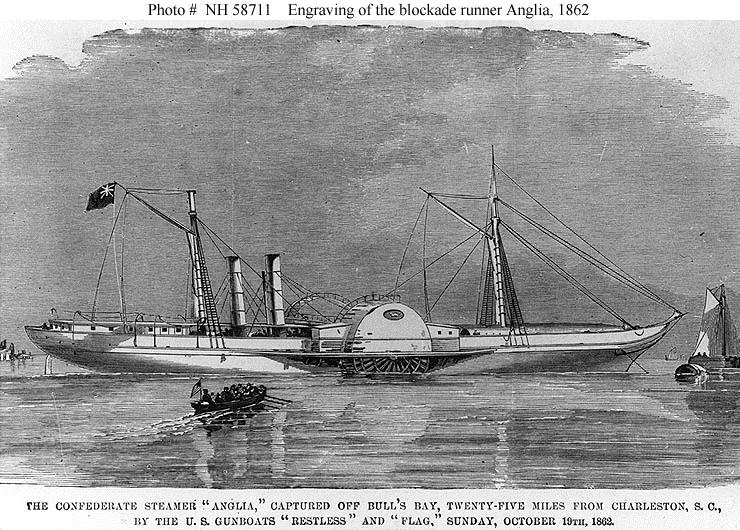
By the time the Confederate Government recognized their embargo as a failed policy, the blockade had become markedly more effective, prices of needed military supplies had risen due to demands of the War, and the value of the Confederate dollar, backed only by the word of the Confederate Government, had fallen to a fraction of the original face value. Furthermore, many blockade runners found cargoes of luxury items, rather than military supplies to be more financially rewarding, further damaging the Confederate military effort.

Blockade Runner
Hindsight is of course often a 20/20 vision of what should have or could have been done differently. In this case a better plan for the Confederates in 1861 might have been to conduct a massive shipment of the available cotton to Europe where it could have been stored in the event of a long war, and then used as a financial underpinning for the Confederate paper money. Few people in 1861 predicted a long or protracted war. The Confederate policy of States Rights might very well have led to legal challenges to the authority of the government to take such drastic action.

In the Ken Burns Series ‘The Civil War’ there is a quote stating the on the tombstone of the Confederacy is written: 

Confederate President Jefferson Davis
"If the Confederacy fails," CSA President Jefferson Davis lamented, "...there should be written on its tombstone: Died of a Theory."

Written by Brother Gerard Devine MD, Patriotic Instructor
Presented by Brother Wendell G. Small Jr, Camp Chaplain
Major General Thomas H. Ruger Camp #1

Lincoln’s Melancholy

Lincoln’s Melancholy

Abraham Lincoln holds a unique place in American History. During his lifetime, and certainly during his Presidency, he was reviled by his political opponents, both in the North as well as in the South. Following his assassination he was revered as the savior of the nation’s unity in the North and greatly respected and even loved in the South for his mild (compared to what actually happened) Reconstruction policies. Times and opinions change, however, and Southerners now regard him more as did their war time ancestors, not as did their 20th century forbearers.

Historians have written about the shifting of the fortunes Lincoln’s reputation and have attempted several explanations to account for this change.  Some have reasoned that Lincoln was motivated by racial or economic factors. Others have commented on his supposed periods of depression, which in the 19th century was referred to as ‘melancholy’, and tried to portray him as being in the grips of mental illness, that he was something of a manic depressive, which the psychiatrists now call the bi-polar state. In other words, his reputation is erratic because his behavior was erratic.
It is always a difficult task to diagnose mental conditions, and doubly so when the patient has not been personally examined by the diagnostician. Moreover, the word ‘depression’ has many different meanings, and has to be carefully defined by the user. A review of some of the incidents of Lincoln’s life should give any armchair psychiatrist pause before trying to attach a label of any mental illness to the man.

Lincoln’s early life was scarred by a harsh father, and only somewhat eased by a kind stepmother.  His first love of his life, Ann Rutledge, died at an early age, and his subsequent courting of Mary Todd was tumultuous, to say the least.
Abraham and Mary Todd Lincoln
The marriage was also marked by recurrent wifely tantrums, as reported by contemporaries, but nonetheless the relationship managed to endure. 

A son, Edward, died before the election and this loss was understandably difficult for both parents to bear.  

Edward Baker Lincoln
When the Lincolns took office on March 4, 1861, Mary’s achievement of her lifelong ambition to be First Lady should have given her the happiness she always craved.  Instead the War torn the nation apart, and several of Mary’s relatives, who disliked Lincoln to begin with, openly served the Confederacy and exposed her to charges of disloyalty. These divisions of her family, coupled with her extravagant spending habits were sources of criticism both for Mary and also for the President, who was dealing with the Fort Sumter crisis, and could afford little time to be so distracted.

The War had barely begun when Col Elmer Ellsworth was shot and killed in Alexandria, Virginia in May 1861. 

Col. Elmer Ellsworth 
Ellsworth was regarded as a son by the President, and his death was an intensely painful experience for Lincoln, one which he was trying to come to terms with when the first Battle of Manassas/Bull Run was fought.

Col. Edward Baker
In October of that year, Lincoln’s close friend and political ally Col Edward Baker, for whom his deceased son had been named, was killed at the Battle of Ball’s Bluff, causing another heavy personal burden for Lincoln, who was then entangled in the diplomatic issue of the Trent Affair and trying to avoid war with Great Britain.

In February 1862, 11 year old Willie Lincoln died in the White House.

Lincoln and Son Willie
Perhaps the favorite child of the family, Lincoln’s grief over Willie’s death not only severely strained his own emotions, but he was powerless to deal with his wife’s intense anguish, and the exacerbation of her already erratic behaviors to the point of, and perhaps beyond, the bounds of sanity.  Two weeks later, he was faced with the issue of the Confederate ironclad Virginia (Merrimack).

In June and July of 1863, the twin crises of Gettysburg and Vicksburg competed for Lincoln’s attention. However, Mary had sustained a life threatening head injury during a buggy ride, and spent several weeks in uncertain recovery, which was by no means guaranteed. In September of that year, the Confederates managed to win a great (but essentially meaningless for them) victory at Chickamauga. Confederate General Ben Helms was killed in the action. 

Confederate General Ben Helms
He was the brother in law of the Lincolns, and was apparently one of the few Todd relatives who both was liked by and who in turn liked Lincoln. Mourning at the White House for the fallen general was sincere, but had to be conducted in secret in order to allay the rumors of disloyalty which were always just below the surface for anyone to use to criticize the President.

The Overland campaign in 1864 was not only bloody, but appeared to be at best a stalemate, not a victory. Lincoln faced bitter opposition for his re-nomination by the Republicans due to the perception that he could not be re-elected. Only Sherman’s capture of Atlanta and Sheridan’s dramatic ride to victory at Cedar Creek in September and October enabled Lincoln to win on a Union, not Republican, Party ticket.

The spring of 1865 should have been a happy time for the Lincolns. The War was close to being won, and the plans for peace were being made. Critics of the President then took aim at his son Robert, sometimes referred to as ‘Prince of Rails’, who had spent the war safely at Harvard. 

Robert Todd Lincoln
Lincoln was agreeable for Robert to serve in the military, and was uncomfortable with the charge that he sent other men’s sons to fight, but kept his own son in safety.  Mary was bitterly opposed to placing her son in such danger. As a compromise, General Grant secured Robert a safe from the battlefield staff position.  This protected Lincoln from the somewhat justified critics, but earned the unending hatred of the by now overtly unbalanced Mary. During a visit in late March by the wives of several dignitaries and officers, including Mrs. Grant, Mary exhibited such an embarrassing emotional outburst that Mrs. Grant refused to accompany the Lincolns to their fateful visit to Ford’s Theater in April.

Assassination at Ford Theater 

Mary Todd Lincoln in her Mourning Cloth
The trials that Lincoln faced both before and especially during his time in the White House make the assumption of mental illness difficult to sustain. Indeed, his ability to persevere in the face of such trials speaks volumes for his essential mental stability.

Presented: Brother Gerard Devine MD, Patriotic Instructor
Major General Thomas H. Ruger Camp #1.

A Plot in Baltimore

Presented: October 11, 2014

The Plot in Baltimore to Assassinate Abraham Lincoln
- Fact or Fiction - 
Implications for History

The Republican Ticket

In November 1860 Abraham Lincoln was elected President of the United States. He was winner due to the division of the Democratic Party into Northern and Southern wings, which predicted the war soon to follow. Lincoln failed to win a majority of the popular votes, and indeed, failed to win any votes in the Deep South where he was not even placed on the ballots.

The election of this minority and sectional candidate was the spark that lit the fuse of Secession, first of South Carolina, followed by Mississippi, Florida, Alabama, Georgia, Louisiana and Texas. On the 4th of February of 1861 delegates from these states (Texas excepted) met in Montgomery, Alabama to form their own new political entity: the Confederate States of America. Meeting behind closed doors the delegates adopted a provisional constitution by the 8th, and a provisional President on the 9th.

Jefferson Davis

The day after he was notified of his selection, Jefferson Davis left his home in Brierfield Mississippi and arrived, sternly triumphant, in Montgomery on the 16th, was sworn in on the 18th and started his Presidency. This pace of accomplishment in American political life has not been matched before or since. It was said, with grim justification that “The man and the hour have met.”

In contrast to the largely popular and uncontested travels of Davis, Lincoln also had to make his way to Washington City to take command of what remained of the United States.

Lincoln left Springfield on February 11th, crossing over into Indiana, then Ohio, followed by Pennsylvania, New York and New Jersey, again entering Pennsylvania and the city of Philadelphia on the 21st. Along the route he was greeted by both supporters and the merely curious, was officially declared the winner of the Presidential Election by the Electoral College on the 12th,  was feted by civic banquets and receptions, and was guarded by an informal company of friends, political cronies, and a few military officers loosely managed by William S. Wood. This was an altogether inadequate arrangement.

Presidential Train

The last leg of the journey required Lincoln to pass from Philadelphia through Baltimore, change trains-a journey of approximately a mile - and then go on to Washington City. Changing trains in cities was reflective of the state of the art of railroading in the 1860s, due not only to the danger of fires and explosions, but also the multiple small distance lines that completed with one another. Baltimore was unique in many ways as a stop in the Lincoln itinerary, it was part of Maryland – the only slave state on the tour, it was the only city that did not plan an official welcome to the Lincoln, which in the other cities was made part of the change of trains procession, and, most ominously, had made no security arrangements for the President Elect’s party. This last omission was not easily excused given that the President elect had daily received threats of death by gun knife poisoned ink and even a spider filled dumpling. The pro Southern sympathies of Baltimore Mayor George William Brown, Baltimore Chief of Police Marshal George Proctor Kane and Maryland Governor Thomas Holliday Hicks were instrumental in contributing to this lack of security.

Samuel Morse Felton

In Philadelphia railway executive Samuel Morse Felton, president of the Philadelphia, Wilmington and Baltimore Railroad was alerted by an employee, George Stearns that a plot was forming in Baltimore. Felton believed that the president-elect and those surrounding him had failed to grasp the seriousness of his position. Rumors had reached Felton that secessionists might be mounting a “deep-laid conspiracy to capture Washington, destroy all the avenues leading to it from the North, East, and West, and thus prevent the inauguration of Mr. Lincoln in the Capitol of the country.” For Felton, whose track formed a crucial link between Washington and the North, the threat against Lincoln and his government also constituted a danger to his railroad.

“I then determined,” Felton recalled later, “to investigate the matter in my own way.” By the end of January, with barely two weeks remaining before Lincoln was to depart Springfield, Detective Allan Pinkerton was on the case.

Allan Pinkerton

History has not been kind to Pinkerton’s role in the Civil War. His wildly exaggerated estimations of the Confederate forces facing the ever cautious General McClellan in the Peninsular Campaign in 1862 left the reputations of both men in doubt. In 1861 however he was considered to be a brilliant and skilled operator. He and his associates, both male and female, soon discovered what they claimed to have been a determined plot to assassinate Lincoln while he was in transit in or near Baltimore.


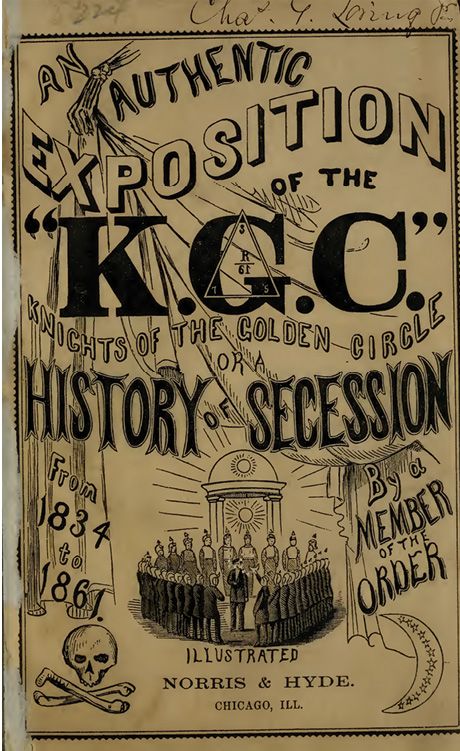
Historians disagree on the validity of the existence of the plot, but Pinkerton was convinced that members of the Knights of the Golden Circle and other societies of Southern sympathizers such as the paramilitary National Volunteers (officially the Breckinridge and Lane Club) were in active conspiracy.

Knights of Golden Circle Broadside

He befriended Otis K. Hillard, a known Southern loyalist, who introduced him to William H.H. Turner, clerk of the Baltimore Circuit Court, Cypriano Ferrandini, a barber in Barnum’s Hotel, a known hangout for Southern Partisans, quoting Ferrandini as saying “If I alone must do it, I shall- Lincoln shall die in this city. Unknown to him and acting independently on the orders of General Winfield Scott, were detectives from New York City, sent by Superintendent John Kennedy, who were also investigating possible plots.

Inauguration of President Abraham Lincoln


Presented: Brother Gerard Devine MD, Patriotic Instructor
Major General Thomas H. Ruger Camp #1